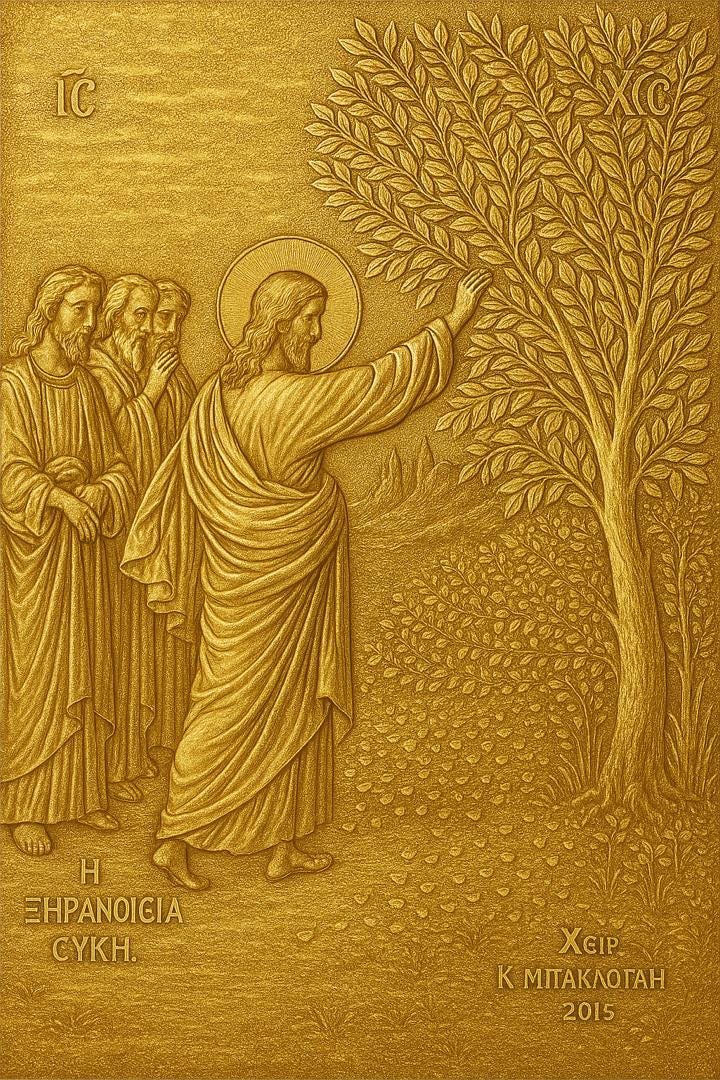
Is Protestantism The Fig Tree?
So many leaves of miracles, but are there as many fruits?


Contemporary Protestantism often appears vibrant—alive with visible gifts, charismatic phenomena, and constant spiritual activity. From a distance, it resembles the fig tree Christ approached: full of leaves, movement, and the appearance of life. Miracles, manifestations, and shifting displays of “gifts” adorn its branches, creating an outward impression of spiritual vitality.
Yet a tree full of leaves is not the same as a tree bearing fruit. And when the Lord draws near, would He find the fruits of repentance? Or the foliage of religious excitement—leaves without roots, signs without asceticism, energy without the means of cultivation. Beneath the surface, there are little to no ascetic disciplines, no guard rails against heresy, no saints to guide the faithful, no living tradition to anchor doctrine, no continuity with the historic Church, and no objective way to discern grace from deception.
Asceticism vs Comfortable Christianity
Many Protestants instinctively distrust words like “tradition” or “religion,” as if Christianity were meant to be a spontaneous, purely personal movement centred on sincerity, emotion, and a private relationship with Jesus. Anything structured, ascetical, or historically rooted is dismissed as “man-made religion”. But this strips Christianity of its objective practices and turns it into a subjective experience validated by feelings, emotional worship, and selective readings of Scripture.
This mindset is often framed with phrases like “as long as you worship God” or “it’s just you and Jesus,” which sound spiritual but remove the guardrails Christ gave through His Church. Yet Christianity was never meant to be self-help or comfortable. The very “religious” traditions Protestants reject are the pathways to the self-denial Christ commands. They teach us to die to the self, not indulge it with emotional highs or personalised spirituality.
And when this subjective model is justified by sola scriptura—which becomes sola my-interpretation—it directly contradicts the apostolic warning that “no prophecy of Scripture is of any private interpretation” (2 Pet. 1:20). Detached from tradition and their heritage, the result is fragmentation, innovation, and inevitable heresy.
The Structural Problem: A System Without Guardrails
Many Protestants are sincere and zealous Christians, but even the greatest effort put into the wrong system cannot yield the fruit Christ desires—just as Jesus warns that many will say “Lord, Lord” yet still lack the substance of true obedience. Its lack of apostolic tradition — the first and major guardrail — denies it an objective stance on crucial matters of the faith, namely:
Apostolic tradition
Conciliar interpretation
Ascetic discipline
Sacramental grace
Holy elders and saints
Liturgical continuity
An unfortunate example of this absence of guardrails is the completely un-unified way Protestantism treats the Eucharist. Everything varies—its frequency, its meaning, its seriousness, even whether it is necessary at all. For many, it is taken only occasionally; for others, it is purely symbolic; and for still others, it is an optional act of remembrance rather than a life-giving mystery. Yet Christ Himself declares, “Unless you eat the flesh of the Son of Man and drink His blood, you have no life in you” (John 6:53).
In addition, because Protestantism is guided by sola scriptura, it frequently constructs false dichotomies—forcing complex issues into rigid either/or frameworks—which in turn opens the door to heresies that the Church has long recognised and condemned. This approach exposes how cut off it is from the conciliar interpretation of Scripture preserved through Holy Tradition, leaving believers without the guidance necessary to navigate complex theological questions faithfully. Thus, this leads to a reliance on “alternative ways” to validate doctrine—emotionalism, signs, cultural adaptation, and creativity—designed to make the faith more palatable to the masses.
Look at this post to see how a system without guardrails is an issue:
How a System Without Guardrails Justifies Itself
A. The Need for “Signs”
Without the sacramental and historical marks of the Church, Protestantism often turns to “signs” to validate itself. This is especially evident in its emphasis on outward charismatic displays—claims of the “outpouring of the Holy Spirit,” speaking in tongues, and other spectacular manifestations—used as proof of spiritual authenticity.
Yet this is a dangerous mindset, for our Lord warns: “Many will say to me on that day, ‘Lord, Lord, did we not prophesy in your name, and cast out demons in your name, and do many mighty works in your name?’ And then I will declare to them, ‘I never knew you; depart from me, you workers of lawlessness’” (Matthew 7:22–23). These are not outsiders, but brothers and sisters turned away despite the “miracles,” showing that signs alone cannot confirm true faith.
B. Signs Cannot Prove Doctrine
Scripture warns that signs are not proof of truth. Although signs may accompany true doctrine, it is not defined by them. Demonic powers can also perform “miracles” to deceive others. An example of this is found in 2 Thessalonians 2:9–10, where Paul warns of “the coming of the lawless one… whose coming is in accordance with the activity of Satan, with all power, signs, and false wonders, and with all wicked deception for those who are perishing.”
This is especially devastating for those unable to discern true from false signs, for Scripture warns that a great falling away will come, deceiving even the very elect (cf. Matthew 24:24).. Yet scripture provides the means to discern true doctrine: by examining the fruits of teaching (Matthew 7:15–20) and by adhering to the apostolic traditions handed down by the Church (2 Thessalonians 2:15). Signs and miracles may accompany either, but they cannot define truth—only the fruitfulness and fidelity to apostolic teaching can.
A simple question that should always hang on our heads should be, does this bear the fruit of humility and orderliness? Or an outward display that grants me pride that was never apostolic and historical?
Look at this post for the misunderstanding of speaking in tongues created by this pursuit:
C. Power Replacing Repentance
Displays of “spiritual power” can be mimicked with miracles and signs, but they are never inherently holy. For example, the demoniac in Mark 5 had superhuman strength and could break heavy chains—clearly beyond human ability—yet he was far from holy. Unfortunately, parts of Protestantism often focus on acquiring spiritual “power,” even organizing entire programs around it. Though zealous and sincere, this emphasis opens participants to demonic influence and deception (prelest), rather than true holiness.
Satan himself demonstrated this tactic in the second temptation of Christ, urging Him to jump from the temple to display God’s power (Matthew 4:5–7)—an attempt to turn zeal into spectacle and pride. Nevertheless, God makes clear how true holiness and spiritual experience are attained—not through the pursuit of power, but by purifying the heart through repentance, as Christ Himself taught: “Blessed are the pure in heart, for they shall see God” (Matthew 5:8).
Repentance is not a side quest—it is the central, and dare I say, the primary goal of the Christian life. From genuine repentance flows all other virtues and spiritual growth, for God faithfully provides for our needs when the heart is rightly turned toward Him.
The Consequences of Subjectivism
A. Creativity as a Replacement for Tradition
Protestantism often treats creativity as something crucial to be held onto. This stems from what I stated before when it comes to the disdain for “rigid religious activities”. This bleeds down to things like worship styles, pastoral methods, and even “Church brands.” Many modern preaching styles, in an attempt to be more “palatable” to audiences, rely on trendy methods designed to be “engaging” rather than faithful to the depth and rigour of the Gospel.
Sermons are often built around self-help themes such as “Unlock Your Potential,” “Find Your Best Life,” or “How to Be Happy,” rather than repentance, obedience, or the cross. This strips Christianity of the established holiness God carefully sought to preserve through tradition. As He instructed His people, “You shall teach them diligently to your children, and shall talk of them when you sit in your house, and when you walk by the way, and when you lie down, and when you rise” (Deuteronomy 6:7). God’s intention was for faith and virtue to be transmitted through deliberate, lived practice—not reduced to emotional trends or subjective experience.
B. Trendiness Over Sobriety
The lack of apostolic and conciliar tradition makes protestantism’s foundation a shifting sand that can be swayed by trends. It breeds an environment where outward displays of worship styles are engineered to be entertaining and engaging for the audience. Although with sincere motives, it is toward the self as the audience, not God. God, in his mercy, desires sober and reverent worship, which has always been the pattern, as seen in this post below.
C. “Relationships Without Religion
“It’s just me and Jesus” is a statement that has now become the norm, or further statements like “Christianity is not a religion; it’s a relationship.” They sound right, but when examined, these kinds of statements, when practised seriously, can open the door to heresies. The rejection of religion leads to a spirituality untethered from truth, and even to a subtle denial of Christ’s words when He established His Church. Scripture affirms the Church’s essential role in preserving truth: “The Church of the living God, the pillar and foundation of the truth” (1 Timothy 3:15).
Without this anchor, faith becomes subjective and vulnerable to error. Beyond this, it opens the Christian to elevating subjective experience above doctrine, denying the necessity of ascetic struggle, and treating salvation—theosis—as arbitrary rather than objective. Without concrete examples and the guidance of tradition, faith becomes a purely personal experience, disconnected from the lived reality of the Church and the saints.
The Absence of Saints and the Absence of Fullness
Protestantism cannot produce saints in the ancient, Orthodox sense, because it lacks both the fullness of the Church and the unity necessary to recognize and venerate them. Its emphasis on subjectivism and personal experience prevents the communal discernment that identifies true holiness. The Saints serve as living anchors of the full embodiment of the Gospel—not through miracles alone, but through the visible fruits of the Spirit that reveal a sanctified heart.
For example, St. Paisios of Mount Athos once prayed, “Lord, You can put me in hell and remove a sinner, but please do not cast me away from Your presence,” or when he prayed to bear the cancer of a woman in her place. To most, this might seem extreme or even “insane,” yet it perfectly exemplifies Christ’s call to absolute humility, self-denial, and love for God above all else. The saints teach that true holiness is measured not by outward displays of power or emotion, but by obedience, repentance, and union with God, even at the cost of one’s own comfort or reputation.
How do you know you are not deceived? And The Call.
The question is now upon protestants: “How do you know you are not deceived?” Before we go further, it’s important to address a common pattern that emerges when these questions are raised. Protestants often appeal to Scripture, but the question remains: how do you know what Scripture truly says without apostolic tradition? The usual answer is, “The Holy Spirit guides us.”
But what if another person claims the same, while distorting the truth and accompanied by signs? The result is a circular logic: Scripture is interpreted by the Spirit, but the Spirit is verified by one’s reading of Scripture—leaving no objective anchor and opening the door to endless contradiction and deception. Returning to the question: without an objective anchor, how can one guard against heresy in a system that is divided, subjective, and severed from its roots? Without:
Apostolic tradition
Conciliar interpretation
Ascetic discipline
Sacramental grace
Holy elders
Liturgical continuity
…there is no reliable way to discern truth. Emotion, power, and creativity are not criteria of truth; they can all deceive. Only the fullness of the faith, preserved and transmitted by the historic, apostolic Church, provides the safeguard against error.
The Call
Christians must anchor themselves in the fullness of the faith, remaining within the guardrails established by the Church—guardrails that include apostolic tradition, conciliar interpretation, ascetic discipline, sacramental grace, holy elders, and liturgical continuity. Faith cannot be grounded in emotion, creativity, or displays of power, for these are unreliable and often deceiving.
Instead, believers are called to live within the historic, apostolic, unchanging Church, where doctrine is safeguarded, holiness is modeled by saints, and the path to theosis is clearly marked. Relationships, spiritual growth, and discernment must be rooted not in vague personal experience or subjective spirituality, but in true religion—the sacramental and ascetic life Christ Himself established, through which grace is bestowed, hearts are purified, and genuine holiness is cultivated.
Implore you all to look into Eastern Orthodoxy with an open mind, with this I pray: Lord Jesus Christ, have mercy on us all, for we are easily deceived